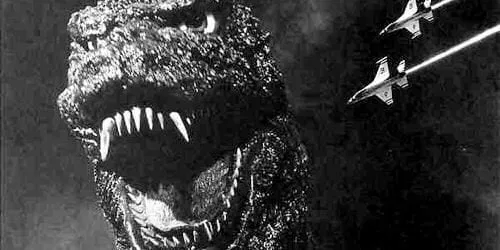
The movie known by a lesser known name than Godzilla, it is about an after a dinosaur-like beast – awoken from undersea hibernation by atom bomb testing – ravages Tokyo, a scientist must decide if his similarly dangerous weapon should be used to destroy it.
Storyline
When 17 vessels explode and sink near Odo Island, Professor Kyohei Yamane, his daughter Emiko and the Marine Hideto Ogata head to the island to investigate. Soon they witness a giant monster called Godzilla by the locals destroying the spot. Meanwhile Emiko meets her boyfriend, the secluded scientist Serizawa, and he makes she promise to keep a secret about his research with oxygen. She agrees and he discloses the lethal weapon the Oxygen Destroyer that he has developed. When Godzilla threatens Tokyo and other Japanese cities and the army and the navy are incapable to stop the monster, Emiko discloses Serizawa’s secret to her lover Ogata. Now they have to convince Serizawa to use the Oxygen Destroyer to kill Godzilla.
Our Thoughts on Gojira (1954)
Godzilla or otherwise known a Gojira was the debut of the legendary titular character and arguably one of the most high profile pieces of Japanese cinema to date.
It tells the story of this gigantic creature coming out of the ocean and going on the warpath after being woken by nuclear explosions. The humans argue as to what to do with the situation, kill or study. But how do you kill something that big and that has already withstood massive radioactive blasts?
Godzilla is very ahead of its time and though the sfx are badly dated they look great for something made in the 1950’s. For the most part it looks and is acted really quite well, though our leading lady was seven shades of awful.
One of the movies biggest flaws is its pacing. The movie doesn’t have a traditional beginning, middle and end in fact the finale really creeps on you and isn’t all that great itself.
Regardless of its flaws Godzilla has to be considered a classic that launched a franchise that is still ongoing over 6 decades later.
6 out of 10 Stars
Trivia
Toho’s sound department tried numerous animal roars for Godzilla, but felt they were unsuitable for an animal of such immense size. The film’s music director, Akira Ifukube, came up with Godzilla’s roar by rubbing a coarse resin-coated leather glove up and down the strings of a contrabass (double bass), and reverberating the recorded sound. Also, Godzilla’s thunderous footsteps were made by beating a kettle drum with a knotted rope.
Stop-motion animation was rejected for this film because of the amount of time that it would take. Special effects director Eiji Tsuburaya sincerely wanted to use this method, but he faced the grim reality that there was not enough people in Japan with enough experience in this technique and that Toho would never give him the time he needed due to their tight production schedules. Tsuburaya had to pioneer the techniques of suitmation which would make the production more feasible, though no less difficult. One benefit of this method was in depicting Godzilla’s enormous size since, if a stop-motion puppet had been used, it would have required miniatures at a much smaller scale, resulting in less detail and destruction. The film does makes use of stop-motion animation to enhance a few brief scenes in which a vehicle crashes and Godzilla’s tail twitches.
One of the most famous legends regarding the production of this film has director Ishirô Honda and special effects director Eiji Tsuburaya on the observation deck of one of Tokyo’s buildings. They were planning Godzilla’s path of destruction when visitors on the deck overheard their conversation and became concerned. The pair was stopped by the authorities and questioned.
The Godzilla suit used for the film was so hot inside that suit actor Haruo Nakajima would frequently faint. According to Nakajima, temperatures inside the suit reached up to 60 degrees Celsius (or 140 degrees Fahrenheit) due to the hot studio lights and it was not uncommon for one cup of Nakajima’s sweat to be drained from the suit. Special effects director Teruyoshi Nakano, who worked with Nakajima in the later Godzilla films, described his admiration for the actor, stating “Inside the Godzilla suit, it was very dark, lonely, and isolated. Usually the person who wears the suit becomes nervous and anxious. During summertime it’s very hot, it can become hell in there. But Mr. Nakajima always persevered. He acted in the suit underwater, he was buried underground, he withstood pyrotechnic explosions…and through it all he was always Godzilla.”
An often-repeated myth is that the productions of both this film and Seven Samurai (1954) nearly drove Toho into bankruptcy. This neglects to mention a third Toho film made that year, Samurai I: Musashi Miyamoto (1954). All three of them were the most expensive Japanese films made up to that point and big financial risks for Toho. However, there is little evidence to suggest that Toho was ever at risk for bankruptcy. Toho released a total of 68 feature films that year, the most successful of which were “Seven Samurai”, “Samurai I: Musashi Miyamoto”, and “Godzilla”, in that order.
If you like this film, be sure to to check out our Ultimate Horror Movie Hub

So what do you think? How many of these scary movies have you seen? Do you have any others to add to the list? Let us know in the comments section and please consider joining our Facebook page, Scary Movies at the Fort. Each October we host the 31 Nights of Horror. Check us out.
Also, be sure to check out our Complete List of Dracula, Frankenstien, Wolfman, and The Mummy, and Universal Monster Movies.
We have compiled our Ultimate Horror Movie Hub