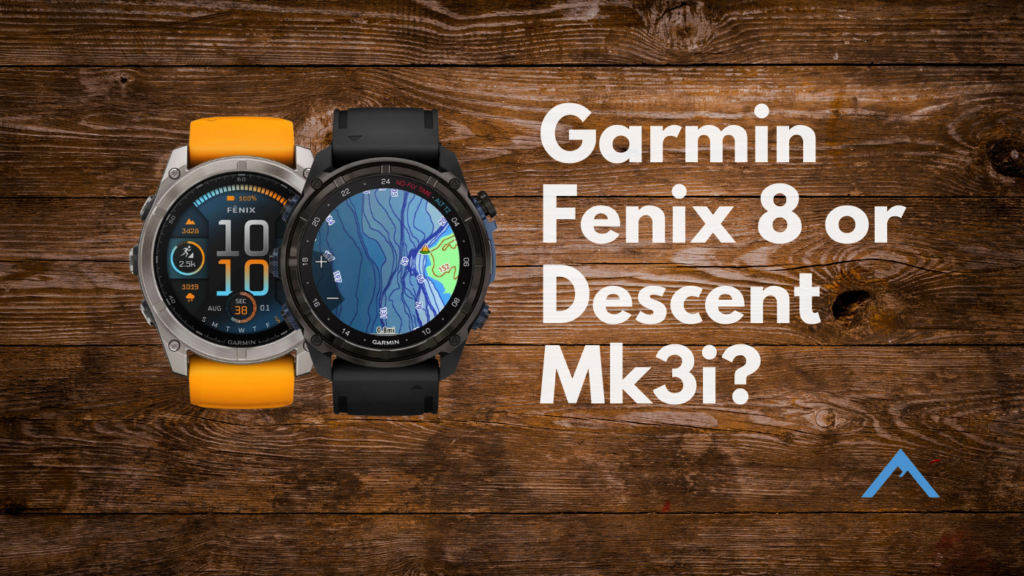
A year ago, we called the Garmin Descent Mk3i one of the most impressive pieces of adventure technology ever built.
At the time, that statement was easy to justify.
The Mk3i combined premium multisport smartwatch features with professional-grade dive computer capabilities. For divers, adventurers, and outdoor enthusiasts, it was among the few devices suitable for both daily use and underwater exploration. Air integration, diver communication, and advanced dive planning established Garmin as a serious competitor to dedicated dive computer manufacturers.
Then Garmin released the Fenix 8.
Initially, the Fenix 8 appeared to be a modest update to Garmin’s flagship outdoor watch. However, after extensive testing in diverse environments, we were prompted to reconsider its capabilities:
If you are not a dedicated diver, do you really need the Descent Mk3i anymore?
The answer depends entirely on the type of adventurer you are.
Two Watches, Two Philosophies
The easiest way to understand these watches is to recognize that they were designed with different priorities.
The Descent Mk3i is a dive computer that happens to be an excellent smartwatch.
The Fenix 8 is an adventure smartwatch that happens to be a capable dive computer.
That distinction is important.
The Descent Mk3i was purpose-built for serious diving. It offers air integration, diver messaging via Garmin’s SubWave technology, multiple gas mixes, CCR support, technical diving applications, and operational depths up to 200 meters. It is intended for those whose activities often involve underwater exploration.
The Fenix 8 takes a different approach. Garmin prioritized a comprehensive adventure and travel watch by adding a microphone, speaker, voice functions, recreational dive capabilities, an improved interface, and enhanced smartwatch features.
For many users, that may actually make it the more functional choice.
Diving: Where the Descent Still Dominates
The most significant difference is clear.
If diving is your primary activity, the Descent Mk3i remains the clear winner.
The Mk3i supports air integration via Garmin’s T2 transmitter system, allowing divers to monitor tank pressure and communicate underwater using SubWave sonar technology. It also offers technical diving profiles, multiple gas mixes, trimix, rebreathers, and greater depth capabilities than the Fenix 8.
The Fenix 8 introduced recreational scuba and freediving capabilities, marking a significant advancement for the Fenix line. For vacationers, recreational divers, and adventure travelers who occasionally dive, it may be sufficient. However, it lacks air integration and many advanced features that appeal to serious divers.
As someone who has used the Descent series extensively, I still view the Mk3i as Garmin’s flagship dive platform.
But for the first time, the gap between the two watches feels smaller than ever.
Travel
However, the gap between the two models is now narrower than during our testing period. The Fenix 8 traveled to South Korea, the Southern Caribbean, Colorado, Indiana, and numerous locations throughout Alaska.
The watch became an indispensable travel companion.
International time zones updated seamlessly. GPS navigation was reliable in both unfamiliar cities and remote trails. Sleep tracking offered valuable insights after long flights, and recovery metrics helped monitor travel fatigue.
Most importantly, the Fenix 8 appears purpose-built for modern travelers.
The addition of a speaker and microphone may seem minor, but in practice, it became a standout feature. When connected via Bluetooth, the watch enables users to answer calls directly from the wrist. This functionality is especially useful during daily activities when accessing a phone is inconvenient.
The Descent Mk3i is an outstanding travel companion.
The Fenix 8 appears specifically designed for travel.
Everyday Use
This category may ultimately determine the preferred watch for most users.
Both watches offer Garmin’s excellent health tracking, GPS navigation, training metrics, sleep analysis, recovery tools, mapping, flashlight functionality, and outdoor performance features.
The key difference is that the Fenix 8 is more refined for daily use.
The updated interface is easier to navigate, voice functions add convenience, and call handling enhances connectivity. The watch serves as a daily companion rather than solely specialized equipment.
For users balancing work, travel, fitness, and daily activities, the Fenix 8 often proves to be the more comprehensive option.
The Connected Ecosystem
Another advantage of the Fenix 8 is its central role in Garmin’s expanding technology ecosystem, enabling testing of integrations with Garmin Connect+, Peloton, and emerging wearable technologies such as the Oakley Meta smart glasses platform.
Workouts sync seamlessly across devices and services. Recovery metrics are consistent throughout activities. Navigation, health tracking, communication, and performance data integrate within a unified ecosystem.
The Descent Mk3i offers many of these features, but the Fenix 8 serves as Garmin’s central hub for a broader adventure lifestyle.
Which Watch Would I Buy Today?
If I were a dedicated diver, dive instructor, divemaster, or technical diver, I would still choose the Descent Mk3i without hesitation.
It remains one of the most capable dive computers available in a smartwatch form factor. Air integration alone justifies its position at the top of Garmin’s diving lineup.
However, if selecting a single watch for travel, hiking, training, fitness, adventure sports, occasional diving, and daily use, I would choose the Fenix 8.
This conclusion is unexpected.
A year ago, I considered the Descent Mk3i to be Garmin’s ultimate adventure watch.
Today, I believe the Fenix 8 holds that title.
This is not due to superior diving capabilities.
It is not.
Rather, it excels in all other areas.
Our Conclusion
The Garmin Descent Mk3i remains the king of Garmin’s diving lineup. The Garmin Fenix 8 may be the leader in all other categories. Both watches represent Garmin’s best offerings. Each is rugged, reliable, and capable of withstanding environments that would damage most consumer electronics.
The essential question is not which watch is superior. Instead, it is where your journeys most often take you. If they take you underwater, choose the Descent Mk3i.
If they take you everywhere, choose the Fenix 8.