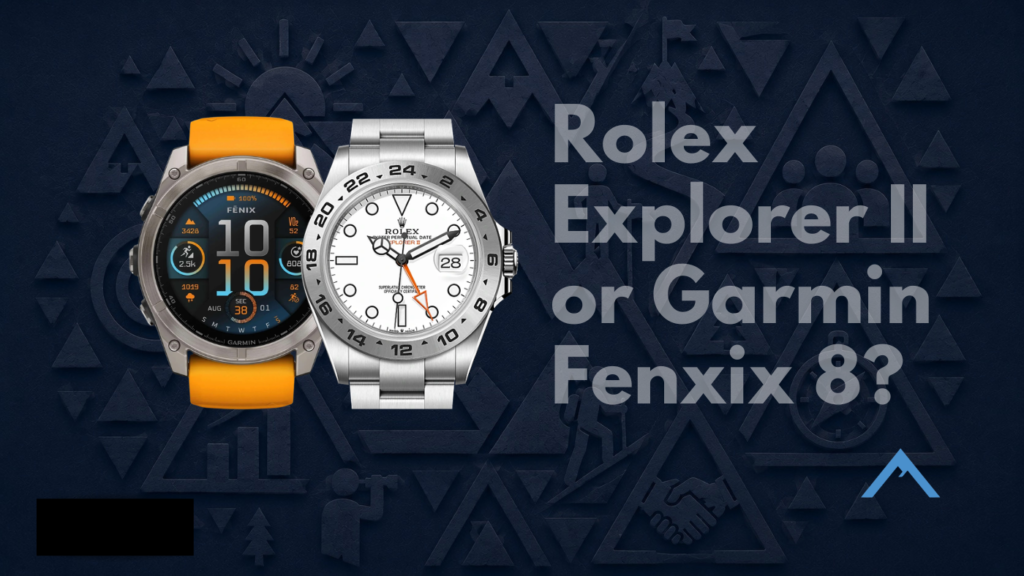
I am often asked a straightforward question: if I could wear only one watch, which would I choose?
For years, my answer has been easy: my Rolex Explorer II Polar Dial.
This answer often surprises people, considering my years of testing advanced adventure technology. I have worn Garmin watches throughout Alaska, during dog races, while teaching leadership programs, during international travel, and on many outdoor adventures. Most recently, I tested the Garmin Fenix 8 extensively and was highly impressed by its capabilities.
Yet each morning, I typically reach for the Rolex first.
My preference is based more on personal significance than technology.
In 2018, after I completed my bachelor’s degree in Outdoor Leadership, my wife Michele gave me a Rolex Explorer II Polar Dial. It was more than a gift; it marked a milestone that reflected years of effort, late nights, sacrifices, and personal growth. Each time I wear the watch, I am reminded of that achievement and of the person who supported me throughout the journey.
That emotional connection is something no smartwatch can replicate.
After months of testing the Garmin Fenix 8, I can confidently say it is one of the most impressive adventure watches I have used. While the Rolex Explorer II remains my preferred everyday watch, the Fenix 8 is a close second.
Notably, these two watches are fundamentally different.
The Rolex Explorer II was created with simplicity in mind. Designed for explorers, mountaineers, and adventurers, it provides reliable timekeeping in extreme environments. It has no apps, notifications, charging cable, or software updates. It simply fulfills its intended purpose. Seven years after receiving mine, it continues to perform as it did on day one.
The Garmin Fenix 8 represents the opposite approach.
In contrast, the Fenix 8 offers a wide range of features, including detailed GPS navigation, offline mapping, weather data, altitude tracking, heart rate monitoring, sleep tracking, recovery metrics, training readiness scores, recreational dive capabilities, hands-free calling, and comprehensive activity tracking. In many ways, it serves as a wearable command center for adventure.
Both watches excel at their intended purposes, which makes the comparison particularly interesting.
The Rolex excels by remaining unobtrusive. It requires no attention and simply works. Whether I am traveling, teaching, training dogs, speaking at events, or spending time outdoors, I feel equally at home. Over the years, the watch has collected scratches, marks, and memories from adventures in Alaska and around the world. These imperfections have become part of its story.
The Fenix 8, by contrast, actively enhances the adventure.
During testing, the watch accompanied me to South Korea, the Southern Caribbean, Colorado’s Red Rocks, the Indianapolis 500, theme parks, airports, hiking trails, dog training sessions, and many miles of outdoor exploration in Alaska. It provided navigation in unfamiliar environments, monitored sleep and recovery during international travel, tracked workouts, recorded hikes, and enabled me to answer phone calls directly from my wrist when my hands were occupied.
A particularly useful feature was the ability to answer calls through the watch when connected to a smartphone via Bluetooth. Whether I was walking dogs, carrying groceries, loading equipment, or moving through an airport, taking calls without reaching for my phone was a genuine quality-of-life improvement. While not a primary selling point, it is a feature I use daily.
The Fenix 8 also demonstrated impressive durability during testing. It withstood Alaskan winters, tropical humidity, long travel days, dusty hiking trails, and repeated sessions in our sauna, where temperatures reached 220 degrees Fahrenheit. While Garmin likely did not design the watch for sauna use, it endured the experience without issue.
For adventure travel, the Garmin holds a clear advantage. Viewing maps, monitoring weather, tracking altitude, recording activities, and receiving navigation guidance directly from the wrist are highly valuable. For modern travelers, the Fenix 8 serves as a navigator, fitness coach, communication device, and health monitor in one.
The Rolex offers none of those things.
And yet that is precisely why I love it.
There is something refreshing about a tool that excels at a single purpose. In a world filled with notifications, alerts, subscriptions, software updates, and constant electronic distractions, the Explorer II stands out for its simplicity. It reminds me that adventure is ultimately about experiences, not data points.
Another important factor to consider is price.
Today, a Rolex Explorer II costs approximately $11,000, depending on availability and market conditions. The Garmin Fenix 8 typically costs around $1,100, depending on the model.
From a value perspective, the Garmin is compelling. For about one-tenth the cost of the Rolex, it offers extensive technology. GPS navigation, mapping, health tracking, diving features, activity tracking, communication tools, and travel tools are all included in a package designed for serious adventure.
If value were based solely on functionality, the Garmin would always come out ahead.
However, watches are not always chosen for their functionality.
Sometimes they are selected to commemorate significant moments.
They can also serve as reminders of our past and personal growth.
That is what my Explorer II signifies for me.
The Garmin Fenix 8 and the Rolex Explorer II are both exceptional timepieces. One relies on advanced software, while the other is powered by a mechanical movement rooted in tradition. Both have earned a place in my collection because they serve distinct purposes.
The Rolex remains my top choice for everyday adventure because of its significance. It is a milestone piece, a gift from Michele, and a memento of an accomplishment that changed my life.
The Garmin Fenix 8 is my second choice for what it enables. It helps me travel farther, train more effectively, navigate unfamiliar places, and gather information that enhances safety and enjoyment.
One tells me the time.
The other helps me determine where to go next.
For me, both have a place.