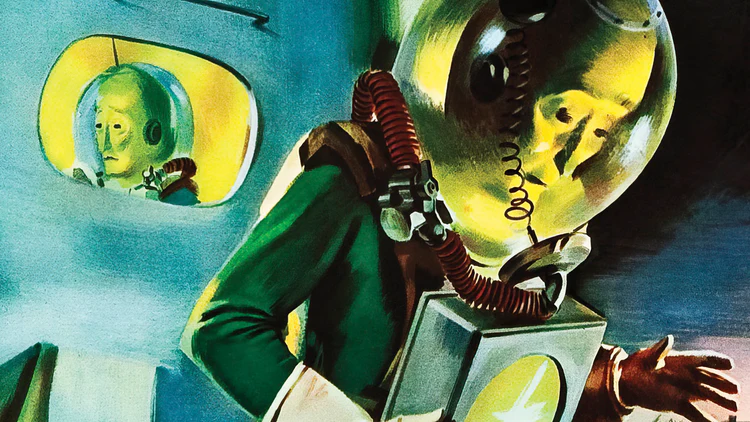
The 1950s transformed horror by dragging it out of gothic shadows and dropping it into laboratories, deserts, and outer space. This was the Atomic Age, shaped by Hiroshima, the Cold War, and a growing fear that humanity’s greatest threat wasn’t the unknown, but its own inventions. Horror fused with science fiction because science itself had become frightening.
Radiation, mind control, alien invasion, and mutation weren’t just plot devices. They were cultural stress fractures. These films asked a chilling question: what happens when progress moves faster than wisdom?
Featured Films
Godzilla
More than a monster movie, this is a national trauma made visible. Godzilla embodies nuclear devastation and the terror of forces humans can no longer control.Them!
One of the defining “big bug” movies. Its radioactive ants reflect fears of unseen fallout and government secrecy in the postwar American landscape.Invasion of the Body Snatchers
A masterclass in quiet paranoia. Identity erodes slowly, mirroring anxieties about conformity, political infiltration, and the loss of individuality.The Fly
Tragic, intimate horror disguised as sci-fi. The terror isn’t the mutation itself, but watching a man understand he can’t be saved.The Thing from Another World
Military authority, scientific hubris, and an alien threat collide in the Arctic. Suspicion and fear are as dangerous as the creature.Forbidden Planet
A philosophical sci-fi horror hybrid. The monster is invisible, born from the subconscious, suggesting intellect without restraint can be deadly.
Defining Themes of 1950s Horror
This era introduced a lasting shift. Horror stopped relying solely on superstition and began reflecting modern systems of power. Government institutions, scientific experts, and technological optimism were no longer trusted. The enemy could be microscopic, extraterrestrial, or psychological.
Visually, these films leaned into stark lighting, wide-open spaces, and clinical environments. Fear wasn’t hidden in castles. It was everywhere, often sanctioned by authority.
Why This Era Still Matters
Atomic-age horror laid the groundwork for later sci-fi and paranoia-driven films, from 1970s conspiracy thrillers to modern existential horror. These stories endure because the fear they tap into hasn’t gone away. Technology still advances faster than ethics, and the consequences still feel out of our control.
Explore more radiation-era and sci-fi horror films
If you’re drawn to horror that reflects real-world anxiety and large-scale dread, the 1950s are essential viewing. This is where modern horror truly begins to look like the world we recognize.
If you enjoy this, be sure to check out our Ultimate Horror Movie Hub

So what do you think? How many of these scary movies have you seen? Do you have any others to add to the list? Let us know in the comments section and please consider joining our Facebook page, Scary Movies at the Fort. Each October we host the 31 Nights of Horror. Check us out.
Also, be sure to check out our Complete List of Dracula, Frankenstien, Wolfman, and The Mummy, and Universal Monster Movies.
We have compiled our Ultimate Horror Movie Hub